



Mazda CX-5 vs. CX-50: What’s the Difference Between These Two Compact SUVs?
Mazda CX-5 vs. CX-50 is a common question at Santa Fe Mazda, since both compact SUVs share a badge but aim at slightly different drivers. The CX-5 leans into a polished, road-focused feel, while the CX-50 was built with a bit more trail-readiness in mind, from its extra ground clearance to its exclusive turbo and hybrid engine options. Neither is a clear upgrade over the other; they’re just tuned for different priorities. Here’s how the two actually compare so you can figure out which one fits your daily drive.
Cargo Space and Interior Room: How Much Do You Need?
The CX-50 edges out the CX-5 with the rear seats up, offering 31.4 cubic feet of cargo room behind the second row compared to the CX-5’s 29.1 cubic feet, useful if you’re regularly loading groceries, sports gear, or luggage without folding anything down. Fold the rear seats flat, though, and the CX-5 actually pulls ahead, with 58.1 to 59.3 cubic feet of total cargo space versus the CX-50’s 56.3 cubic feet. Neither difference is dramatic, but it does mean the right choice depends on how you use the space day to day. If you tend to haul bulkier items with passengers still in the back seat, the CX-50’s extra everyday cargo room behind the second row is the more useful number. If you fold the seats down often for larger hauls, the CX-5 has a slight edge. Browsing Santa Fe Mazda’s new CX-5 inventory is a good way to compare both cargo layouts in person before deciding which one fits your routine.
Size and Ground Clearance: On-Road Polish vs. Trail-Ready
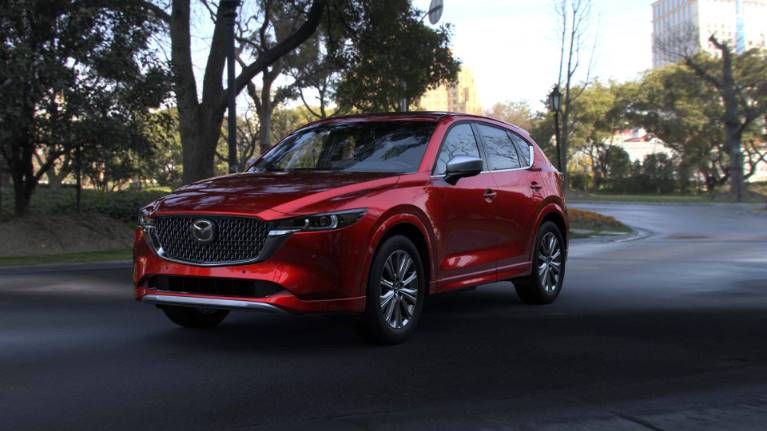
Both SUVs share the same 110.8-inch wheelbase, so they feel similarly sized behind the wheel, but a few dimensions set them apart. The CX-5 measures 184.6 inches long and stands 66.7 inches tall, while the CX-50 stretches slightly longer at 185.8 inches but sits lower, between 63.5 and 63.9 inches depending on trim. Ground clearance tells the bigger story: the CX-5 offers 8.0 to 8.2 inches, while the CX-50 raises that to 8.3 to 8.6 inches, giving it a bit more confidence on rougher forest roads or gravel. Mazda designed the CX-5 as the polished, go-anywhere professional and the CX-50 as more of a trail guide, and these dimensions back that up. If your driving stays mostly on pavement around town, the CX-5’s lower stance and tighter footprint make it easy to live with. If you’re regularly heading out toward rougher terrain, the CX-50’s added clearance is the more useful setup.
Power Options: From Standard to Turbo to Hybrid
Both SUVs start with the same standard 2.5-liter engine producing 187 horsepower, so the base experience feels nearly identical off the line. Where they split is at the top of the lineup. The CX-50 offers an available turbocharged engine that produces 227 horsepower on regular fuel or 256 horsepower when you run premium, an option the CX-5 doesn’t offer. The CX-50 also has an available hybrid powertrain rated at 219 horsepower paired with an e-CVT transmission, giving you a fuel-focused option that isn’t on the CX-5’s engine sheet either. If you want more power or a hybrid option without stepping up to a larger SUV, the CX-50 is the one built to deliver it. If the standard engine is all you need, both SUVs perform about the same, so the choice comes down to which body style and features you’d rather have around that shared engine. Santa Fe Mazda’s service department can walk you through maintenance schedules for whichever powertrain you end up choosing.
Towing Capacity: What Each One Can Handle
Towing capacity is one of the widest gaps between these two SUVs. The CX-5 tops out at 1,500 pounds, enough for a small utility trailer or a couple of personal watercraft, but not much more. The CX-50 starts higher, at 2,000 pounds in standard form, and jumps to as much as 3,500 pounds with the available turbo engine, opening the door to small campers, larger trailers, or a boat you’d otherwise need a bigger SUV to pull. The CX-50 Hybrid sits closer to the CX-5 at 1,500 pounds, so towing capacity depends heavily on which CX-50 engine you choose, not just the body style. If towing matters to your decision, say for hauling gear on weekend trips out toward Los Alamos or the Jemez Mountains, the turbocharged CX-50 is the clear choice between the two. If you rarely tow anything heavier than a small trailer, the difference won’t affect you much either way, and either SUV will handle the job without issue.
Everyday Technology in Both SUVs
Both the CX-5 and CX-50 come with standard all-wheel drive across their lineups, so neither one asks you to pay extra just to get better traction in snow or rain. Where they differ is in the voice assistant built into the dashboard. The CX-5 uses Google Built-in, paired with a 12.9-inch or available 15.6-inch touchscreen and driver personalization features that adjust settings automatically for different drivers. The CX-50 instead offers Alexa Built-in as its voice assistant, giving you a different ecosystem to work with depending on what you already use at home. Neither system is better across the board, it really comes down to whether you’re more comfortable with Google or Alexa running your daily commands. That standard all-wheel drive setup also comes in handy for commuters heading up toward Albuquerque, where highway conditions can shift quickly with the weather. The team at Santa Fe Mazda can walk you through current financing options for either model while you weigh which technology setup fits your routine.
Frequently Asked Questions
What’s the main difference between the Mazda CX-5 and CX-50?
The CX-5 is tuned as a polished, road-focused compact SUV, while the CX-50 adds more ground clearance and exclusive turbo and hybrid engine options built with rougher terrain in mind.
Do the CX-5 and CX-50 have the same engine?
They share the same standard 187-horsepower 2.5-liter engine, but the CX-50 also offers an available turbo engine (227 or 256 horsepower) and a 219-horsepower hybrid powertrain that aren’t available on the CX-5.
Which one has more cargo space?
The CX-50 offers more room behind the rear seats at 31.4 cubic feet versus the CX-5’s 29.1 cubic feet, but the CX-5 has more total space with the seats folded flat, at up to 59.3 cubic feet compared to the CX-50’s 56.3 cubic feet.
Can I get a turbocharged or hybrid CX-50?
Yes. The CX-50 offers an available turbo engine producing up to 256 horsepower on premium fuel, along with a 219-horsepower hybrid powertrain, neither of which is offered on the CX-5.
Can I test drive both the CX-5 and CX-50 at Santa Fe Mazda?
Yes. Santa Fe Mazda keeps both SUVs in stock at 2704 Cerrillos Rd so you can compare them back to back.
Whether you lean toward the CX-5’s polished, road-ready feel or the CX-50’s extra clearance and available turbo or hybrid power, the clearest way to decide is behind the wheel of both. Stop by 2704 Cerrillos Rd in Santa Fe, or call 505-372-0621 to set up a side-by-side test drive, and let the team at Santa Fe Mazda walk you through current offers and financing for whichever compact SUV ends up fitting your routine best.
0 comment(s) so far on Mazda CX-5 vs. CX-50: What’s the Difference Between These Two Compact SUVs?